Sandra Meranda

  • Home
  • About Sandra
    • Information for Buyers and Sellers
  • Blog
  • Contact Sandra

July 1, 2011 by changescapeweb Leave a Comment

St. Charles and St. Louis County Real Estate – Buy Now or Wait?

There are plenty of homes for sale in St. Charles County and St. Louis County.  There are some great deals, but will they get better?  Just because a home drops in price doesn’t necessarily mean that the house will cost less.

Interest rates are key in determining the total cost of the house, and as a result need to be factored in as a major consideration in whether to buy a St. Charles County or St. Louis County home now — or wait.  The following article does a great job of explaining this!

Buy Now or Wait?

by Pat Zaby May 23, 2011 15:59 PM

Uncertainty as to whether prices will continue to fall has to be one of the most common causes of buyer procrastination.  Paying too much wouldn’t be a smart thing but price isn’t the only factor to consider.  Interest rates have as much effect on housing costs as price.

A small increase in mortgage interest rates can offset a significant drop in home prices.  If the price of the home were to come down by 5% but the interest rates were to go up by .5%, the payments might be close to the same.

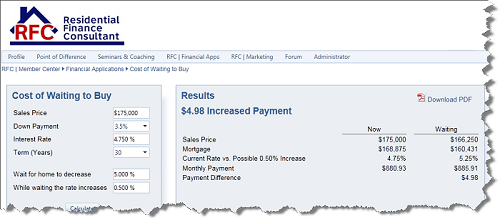
In the example below, if the price of $175,000 home went down 5% but the interest rate went from 4.75% to 5.25%, the payments would actually be $4.98 more at the cheaper price.  If while the buyer was waiting for the home to decrease 5% and the interest rate increased by 1%, the payments would actually go up by $55.30.

Buy-now-or-sell-example

Then, of course, there is always the possibility that the price of the home doesn’t go down but the rate does go up by 1%.  The payments would be $104.58 more per month, each and every month for as long as you have the mortgage on the home.

A Residential Finance Consultant can provide solid information that will help you make better buying decisions.  A home is a place to feel safe and secure, to raise your family, share with your friends and an investment.  It’s an investment in your marriage, your family and your future.  You owe it to yourself to check out the real numbers in your market because every market is different.

A top real estate agent  and mortgage banker can help you make an informed decision about whether it is the right time to buy in St. Charles County and St. Louis County.  My team specializes in St. Charles and St. Louis County.  If you are considering buying a home, please contact Sandra Meranda and I’ll get you moving!

Filed Under: Buying a Home

May 20, 2011 by changescapeweb Leave a Comment

4 Signals It Might be Time to Buy (vs. Rent) Your Home

This is a great article to help people in St. Charles and St. Louis determine if they should buy a home, or rent.

To rent or to buy:  what used to be a given – that you would buy a home as soon as you could afford to – has become an agonizing conundrum for many a would-be homebuyer, in the face of the housing market’s big bust and super-slow recovery.  Low prices seem to create a wide-open window of opportunity, but they also create the concern that prices will keep falling after closing.  And that Catch-22 has hundreds of thousands of buyers-to-be stuck on the fence.

Fortunately, there are handful of life, mortgage and local market signals which indicate that the time *might* be right to hop – scratch that – leap off the fence and into homeownership:

Mortgage rates are going up.  Home prices have been low for the last several years, and in fact are currently looking like they’re heading back down to the same levels they were at the depths of the real estate recession. During this same time frame, interest rates have also been low – this one-two punch has created record-high affordability for the last four years running, causing buyers to believe that this window of opportunity won’t be closing anytime soon.

While prices don’t look like they’ll be skyrocketing anytime soon, interest rates are another story. Rates have been on a rollercoaster over the past few months, and with inflation and Fed rates set to spike later this year, today’s low interest rates might be as good as they’re going to get for a long time to come.  And I mean a very long time – in the next few years, governmental intervention in the mortgage markets is likely to wind down, and that means higher mortgage interest rates are not only inevitable, they’ll probably be here for a long, long time.

Mortgage rates on the rise are one signal that now might be the peak of home affordability, and the peak of the opportunity to buy.

Rents are going up.  Rental rates in many areas are also on the rise – in fact, the foreclosure crisis has acted created additional demand on many markets’ rental housing inventory in several different ways. First, former homeowners who lost homes to foreclosure now need to rent; as well, buyers in foreclosure hot spots have been hesitant to buy, many electing to stay renters far beyond when they would have otherwise. On top of all that, super-tight lending guidelines have stopped even some who would like to buy homes from doing so.  As a result, rental homes are in high demand – and rents are rising.

Rising rents at a time when the prices of homes for sale are low and, in some places, falling?  One more signal that now might just be the time to buy. (Of course, where foreclosures are high, the chances of continued depreciation are, too – to offset this risk, have a long-term plan, to minimize the possibility that you’ll owe more than your home is worth when you need to sell.  Read on for more on how to plan for the long term and minimize your homebuying risk.)

Your income and career are stable for the foreseeable future.  The smartest homebuyers look to their lives, not just the market, for signals about when the time is right to buy. Homebuying is a long, long-term endeavor these days. The goal is to be able to commit to staying in the same place, geographically-speaking, for 7 to 10 years before you buy (more in a foreclosure-riddled market, less in an area that has been more recession-resistant). Most lenders will require that you’ve been at your job – or in the same general field of work – for at least two years before you buy. But that’s the bare minimum – beyond that, you don’t want to be barely beginning a career in which you think you may need to move sooner than that, nor do you want to buy when you’re advanced in your career, but in an industry which is dying or downsizing the workforce in your region (unless you have a strong Plan B).

When you get to the spot in your career where you can realistically project a stable income 7 to 10 years out, life might be giving you a green light to move forward on your homebuying dreams.

You can reasonably predict the home you’ll need in the years to come.  Since successful homeownership requires that you be ready to be in the place for a good number of years, best practice is not just to buy a home with the space and number of rooms you need right now – rather, you should aim to buy the home you’ll need 5, 7 or even 10 years down the road (to the best of your ability to predict, of course). You might be a newlywed with no kids now, but you plan to have them in a few years. Or maybe you’re a newly minted empty nester right now, but can project that you’ll want to retire – and might not want to climb two flights of stairs to get to and from your bedroom – 10 years down the road. Before you buy, you should be in a position to buy the home that meets your future needs – not just your current ones; and that requires that you have a reasonable idea of your life vision and plan for the future.

If you’re able to predict – and afford, at today’s prices – a home with the space, amenity and geographic location you’ll need 7 to 10 years from now, you might be in a good phase of life to get off the rent vs. buy fence.

With that said. . . buying a home is a massive decision and includes multiple, long-term financial and lifestyle obligations, so if one or more of these signals are present for you, that doesn’t mean you have the green light to run out and buy a home tomorrow – rather, it’s a good sign you should begin down that path, if you’re so inclined. You’ll still need to do the work to make sure your personal finances and holistic life picture are also in alignment before you buy, as well of the work it takes to ensure that your real estate and mortgage decisions are sustainable and smart, over the long-term.

It’s not overkill to check in with a mortgage pro, a tax pro, a local real estate broker or agent and a financial planner to make sure all your ducks – not just one – are in a row before you make your move.

This article was written originally published on Trulia by Tara-Nicholle Nelson.

Spring has sprung in St. Charles and St. Louis!  This is the time of year for buying and selling real estate.  There are large numbers of homes at below-market prices & the move-up market has been energized for the Spring.  Interest rates are hovering around 5% & home sale numbers have been increasing every month, it is a great time to list your home also.  Contact me for details today!

Filed Under: Buy vs. Rent, Buying a Home, Renting

March 22, 2011 by changescapeweb Leave a Comment

Sizing Up Homes in a Different Way: New Homes Get Rated on Energy Use

More new homes now will come with energy labels that estimate monthly energy bills, allowing buyers a different way of shopping for homes. The energy labels have been compared to the miles-per-gallon ratings available for cars, which give insight into a car’s fuel efficiency. Likewise, more builders now will give new-home buyers greater insight into how much the home will cost them in utilities–so they have a better gauge to judge the upkeep costs of a home.

Environmental efficiency has become an increasingly important factor in home buying decisions due to rising energy costs. Energy efficient appliances and energy efficient lighting were “very” or “somewhat” important to a majority of home buyers, and heating and cooling costs were at least “somewhat” important to 88 percent of buyers, according to the 2009 Profile of Home Buyers and Sellers by the National Association of REALTORS®.

KB Homes plans to debut its EPG (Energy Performance Guide) on its homes by the end of this month.

“For most people, buying a home is the largest and most important purchase they will ever make, and until now there has been no standard way to communicate a home’s estimated monthly energy costs,” says Jeffrey Mezger, president and chief executive officer of KB Home. “We believe providing the estimated monthly energy costs will not only empower our home buyers, but also change the way people shop for a home. Home buyers can now better understand the estimated energy costs for the home.”

PulteGroup Inc. and Residential Energy Services Network also have teamed up to roll out energy efficiency labels on PulteGroup homes this year. The homes will be tested using the RESNET Home Energy Rating System Index, a measure of energy performance that is recognized by government agencies.

“Providing clear, visible energy ratings for homes makes sense for today’s energy-conscious consumers who want to save on their utility bills and reduce their carbon footprint,” says Steve Baden, executive director, RESNET. “Marketing the energy efficiency of homes is a winning proposition for home buyers, builders, and the environment.”

While these labels apply to new homes, the USA Today recently reported that the U.S. Department of Energy is developing a home energy score for existing homes, which it plans to launch nationally this fall.

So when you are thinking about buying or selling a home in St. Charles or St. Louis County, call me and "I'll get you moving!". 


Originally posted on February 28, 2011 by Melissa Tracey; REALTOR® Magazine

Filed Under: Buying a Home, Home Energy Score

March 10, 2011 by changescapeweb Leave a Comment

10 Steps to Home Ownership

Here's an article from one of my trusted mortgage loan officers that I work with, Dan Main, put together.  It breaks the process down into 10 Steps to Home Ownership to include:

  • Getting ready
  • Finding a Realtor
  • The Mortgage Application
  • Looking at Homes
  • Choosing a Home
  • Securing Funding
  • Making an Offer
  • Securing Homeowner's Insurance
  • Closing
  • Moving In

Understanding the process can help you make decisions at any phase of the home buying process!  So when you are thinking about buying a home in St. Charles or St. Louis County, please keep these in mind.


Buying a home is an exciting time and a wonderful opportunity.  Working with a real estate expert can make it a much easier and less scary endeavor, and can likely help to save you money and headaches down the road. 

If you're thinking about buying or selling a home, call me and "I'll get you moving!".

Filed Under: Buying a Home, Home Ownership

February 27, 2011 by changescapeweb Leave a Comment

Insider Tips for Buying Your First Home

I came across a great article that provides some great insider tips that can help you make decisions at any phase of the home buying process!  So when you are thinking about buying a home in St. Charles or St. Louis County, please keep these in mind.

Buying a home is a process that can take months to happen.  It's important to recognize this process and key considerations along the way.

Stage One: Deciding if is time to buy – Affordability is high, but don't make the decision just based on the market.  Personal considerations such as you life plans, family plans, career plans and financial plans should really be the driver in decision making.

Stage Two: Getting Pre-Approved for your Mortgage – Work with a mortgage broker referred by your real estate agent

Stage Three: House Hunting – it's not always the case that foreclosed homes or short sales – homes which are being sold for less than what the seller owes on their mortgage(s) – offer the buyer a fabulous discount.  You can sometimes negotiate a better deal with an individual seller on a "regular" sale than with a bank on a distressed home sale.

Stage Four: Negotiations – Everyone seems to be an armchair economist/real estate savant.  Don't let your family and friends can cause you to lose your dream home.  Work with your real estate broker or agent to develop a smart strategy – with their experience in your local market – about what price and terms to offer. 

Stage Five: Escrow, Inspections and Underwriting:  Please attend your home inspections.  Home inspectors can help you understand the details and nuances of the home's features and condition, where you're going to require maintenance, can help you understand the costs of the repairs, and refer you to contractors that they trust.

Buying a home is an exciting time and a wonderful opportunity.  Working with a real estate expert can make it a much easier and less scary endeavor, and can likely help to save you money and headaches down the road. 

If you're thinking about buying or selling a home, call me and "I'll get you moving!".

Read the full article Surprising Insider Secrets for the 5 Stages of Buying Your First Home

Filed Under: Buying a Home

  • « Previous Page
  • 1
  • …
  • 5
  • 6
  • 7

Contact Sandra

Cell: 314-691-1320
Office: 636-946-2020
Contact Sandra


ReeceNichols – St. Charles

2171 Bluestone Dr.
St. Charles, MO 63303

Follow Sandra

  • Facebook
  • LinkedIn
  • Twitter
  • YouTube

Habitat for Humanity St Charles County Donations


Copyright © 2026 · Sandra Meranda · This website was Changescaped.

Copyright © 2026 · Executive Pro Theme on Genesis Framework · WordPress · Log in